
Number walls – Grade 1
Number walls for Grade 1: add two neighbouring bricks, fill the wall from the bottom up and find the top brick up to 20.
🎯 What you will learn
- ✓Add two neighbouring numbers
- ✓Fill a wall from the bottom up
- ✓Add confidently up to 20
💡 How it works
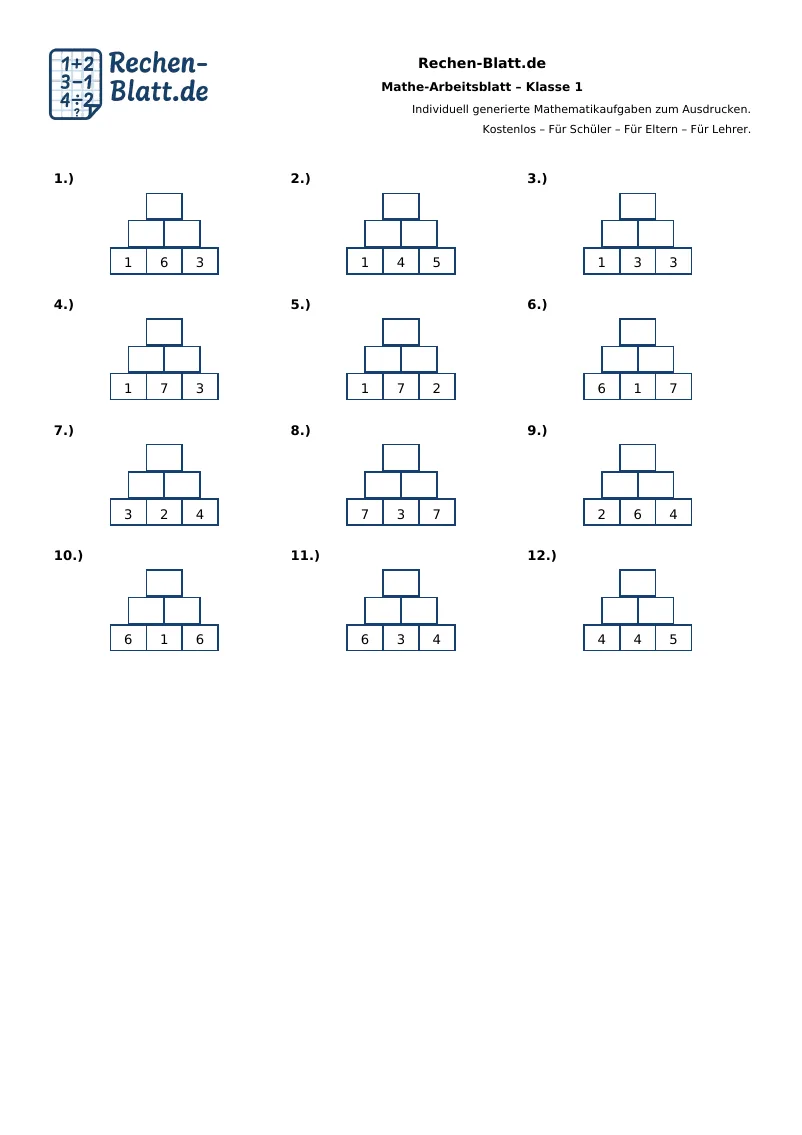
A number wall looks like a small pyramid of bricks. The bottom row has numbers, the rest is empty – you finish the wall with addition.
How it works
💡 Top brick = lower left brick + lower right brick.
Every brick rests on two bricks. Its number is always the sum of those two numbers. So start at the bottom and work upwards row by row.
A wall with three rows contains three additions. The top brick is the result of the whole wall – use it to check your work at the end.
🧩 See the method
✍️ Worked examples
Worked examples 1
The bottom row is 3, 5 and 2. What is the top brick?
- 1.Left brick of row two: 3 + 5 = 8.
- 2.Right brick of row two: 5 + 2 = 7.
- 3.Top brick: 8 + 7 = 15.
✓ 15
Worked examples 2
The bottom row is 4, 6 and 1. What is the top brick?
- 1.4 + 6 = 10
- 2.6 + 1 = 7
- 3.10 + 7 = 17. The middle number 6 counts twice because it lies under both bricks.
✓ 17
⚠️ Common mistakes
- • Adding diagonal numbers instead of the two directly below. Put a finger on the two bricks under the empty one.
- • Starting at the top. A number wall is always built from the bottom.
📝 Try it yourself
1.
2 | 3 | 4
Show answer
5 | 7 → 12
2.
1 | 5 | 2
Show answer
6 | 7 → 13
3.
4 | 2 | 3
Show answer
6 | 5 → 11
4.
3 | 4 | 5
Show answer
7 | 9 → 16
5.
6 | 2 | 1
Show answer
8 | 3 → 11
6.
2 | 6 | 3
Show answer
8 | 9 → 17
Create matching questions
Create a compact printable worksheet or start an online test.
Learn next
FAQ
When can children solve number walls?
As soon as they add confidently to 10, usually from the middle of Grade 1. Three-row walls up to 20 are then ideal.
Why are number walls better than single sums?
Children solve several sums in a row and check themselves with the top brick. This makes practice more varied.